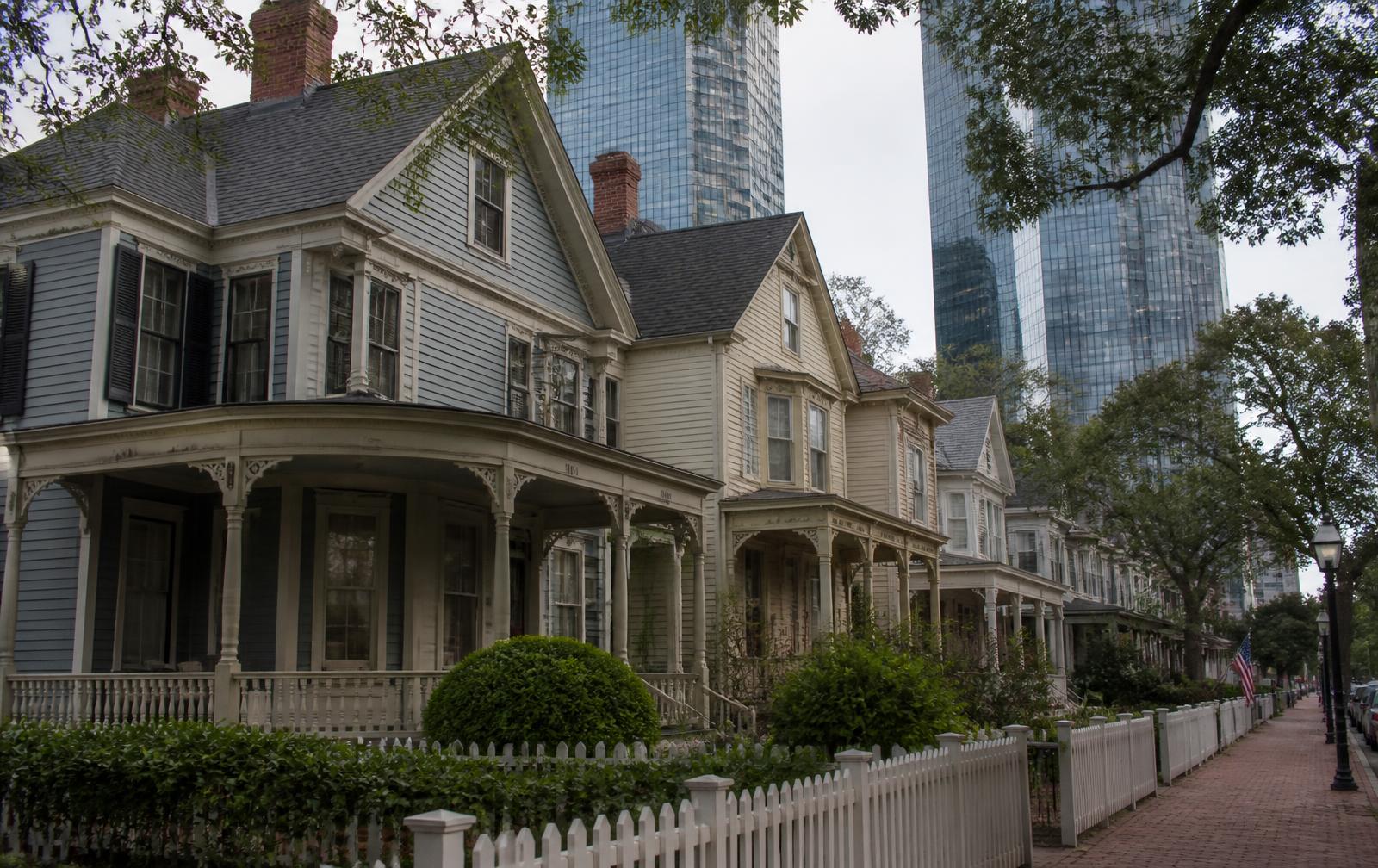
Restored Victorian houses on a Fourth Ward historic district block in Uptown Charlotte

Fourth Ward, in depth

The historic homes of Fourth Ward

A block-by-block look at the Victorian and early-twentieth-century houses that survived Fourth Ward's 1970s preservation revival — and a clear line between those designated historic properties and the majority of Fourth Ward, which is ordinary later-built condominium and apartment stock.

A small historic core inside a much larger modern ward

Fourth Ward is often described, imprecisely, as 'the historic ward,' as though the entire quadrant were nineteenth century. It is not. The locally designated historic district is a compact core of blocks around Fourth Ward Park and Settlers Cemetery. Most of the ward's housing stock — the condominium towers along North Church, the mid-rises on Poplar and Pine — was built in the 1980s, 1990s and 2000s and carries no historic designation at all.

This page is specifically about the surviving historic houses: how they were saved, what governs them today, and how to tell a genuinely designated property from a newer building simply built in a Victorian-adjacent style nearby.

Preservation-led revival begins
1970s
Governing designation type
Local district
Share of Fourth Ward that is historic
Small core
Non-historic, later-built condominium stock
Most of ward

01

How the houses survived

By the mid-twentieth century, Fourth Ward's Victorian housing stock had declined and much of it faced likely demolition, the same fate that had already befallen Second Ward's Brooklyn. In the 1970s, a coalition of preservationists, city officials and lenders took a different approach: rather than clearing the district, they restored surviving houses one at a time, often with below-market financing aimed specifically at rehabilitation rather than replacement.

That effort produced the locally designated Fourth Ward Historic District, one of Charlotte's most cited preservation successes, and it stands in direct contrast to what happened in Second Ward in the same decades — two adjacent quadrants, two opposite policy choices, two entirely different physical outcomes today.

02

What is actually inside the historic district

The protected core runs in blocks around Fourth Ward Park, with porch-front Victorian and early-twentieth-century houses on tree-lined streets. These are the properties most people picture when they imagine Fourth Ward, and they represent a small fraction of the ward's total residential units.

Individually designated landmarks and the broader local historic district each carry their own review requirements, and not every old-looking house in the vicinity is inside the designated boundary. Anyone evaluating a specific address for historic status should confirm it directly against the Charlotte-Mecklenburg Historic Landmarks Commission's designation records rather than assuming from appearance or location alone.

03

What local historic district designation actually controls

Local historic district designation in Charlotte-Mecklenburg governs exterior changes visible from the public right of way — things like window replacement, siding, roofing, additions, fencing and new construction on a designated lot. It does not typically govern interior renovation.

Owners of a designated property generally must apply for a Certificate of Appropriateness before undertaking covered exterior work, reviewed against the district's adopted design guidelines. This process exists specifically to prevent the piecemeal loss of the historic fabric that the 1970s revival worked to save, and it should be factored into any purchase decision involving exterior renovation plans.

04

Not every Fourth Ward property is historic

This is the point most easily lost in casual description of the ward: the great majority of Fourth Ward's housing units are in later condominium and apartment buildings with no historic designation and no Certificate of Appropriateness requirement. A unit in a 1990s mid-rise on Poplar Street is not subject to historic district review, regardless of how close it sits to the Victorian core.

Buyers specifically seeking a designated historic house — as opposed to a condominium in a historic-adjacent ward — should say so explicitly and verify designation status property by property before assuming it applies.

05

Verifying designation before you buy or renovate

Designation status, district boundaries and applicable design guidelines are maintained by the Charlotte-Mecklenburg Historic Landmarks Commission and are public record. The Robinson-Spangler Carolina Room holds historical documentation and photographs for specific houses and can help confirm a property's history.

This page is educational, not a substitute for that direct verification, and it does not constitute renovation, zoning or legal advice.

Questions & Answers

Frequently asked questions

Direct answers to what readers most often ask about this part of Uptown. Each answer cites the primary source it rests on.

All Uptown Charlotte questions →

Is every house in Fourth Ward historic?

+

No. The locally designated historic district is a compact core of blocks around Fourth Ward Park. Most of the ward's housing is in later condominium and apartment buildings from the 1980s through 2000s that carry no historic designation.

Source: Mecklenburg County POLARIS 3G parcel viewer

What can I change on a historic house in Fourth Ward?

+

Interior renovation is generally unrestricted. Exterior changes visible from the public right of way — windows, siding, roofing, additions, fencing and new construction — typically require a Certificate of Appropriateness from the applicable historic district review process before work begins.

Source: Charlotte-Mecklenburg Historic Landmarks Commission

How did the Fourth Ward houses survive when Brooklyn in Second Ward did not?

+

In the 1970s, Fourth Ward pursued preservation-led rehabilitation backed by the city, lenders and local advocates, restoring houses individually rather than clearing them. Second Ward's Brooklyn had already been cleared under federal urban renewal in the preceding decade under a different policy approach. The two outcomes are frequently cited together as a case study in how Charlotte handled its historic housing stock.

Source: Charlotte-Mecklenburg Historic Landmarks Commission

How do I confirm whether a specific Fourth Ward address is historically designated?

+

Check the property directly against the Charlotte-Mecklenburg Historic Landmarks Commission's designation records rather than assuming from its style or location. The Robinson-Spangler Carolina Room can also help confirm a specific house's documented history.

Source: Charlotte-Mecklenburg Historic Landmarks Commission

Topic Cluster

The Four Wards of Uptown Charlotte

First, Second, Third and Fourth Ward — four quadrants, four completely different places.

The Uptown Guide — The Four Wards of Uptown Charlotte

Our Sources

How this page was researched

This guide is independently written and verified against primary public records and official organizations. It is not affiliated with, endorsed by, or representing the City of Charlotte, Charlotte Center City Partners, any condominium association, or any building owner.

Read our full citation methodology and editorial standards
  1. 01
    Local historic districts and designated landmarks

    Charlotte-Mecklenburg Historic Landmarks Commission

    Fourth Ward historic district and individually designated buildings.

  2. 02
    Local history collections and archives

    Charlotte Mecklenburg Library — Robinson-Spangler Carolina Room

    Ward history, the Brooklyn neighborhood, and urban renewal record.

  3. 03
    Unified Development Ordinance and zoning maps

    City of Charlotte

    Uptown Mixed-Use zoning, height, and streetscape requirements.

  4. 04
    POLARIS 3G property and parcel records

    Mecklenburg County GIS

    Parcel boundaries, building footprints, ownership, and sale history.

Figures such as pricing, dues, assessments, tenancy, and school assignment change over time. Always confirm current details directly with the source before making a decision.